
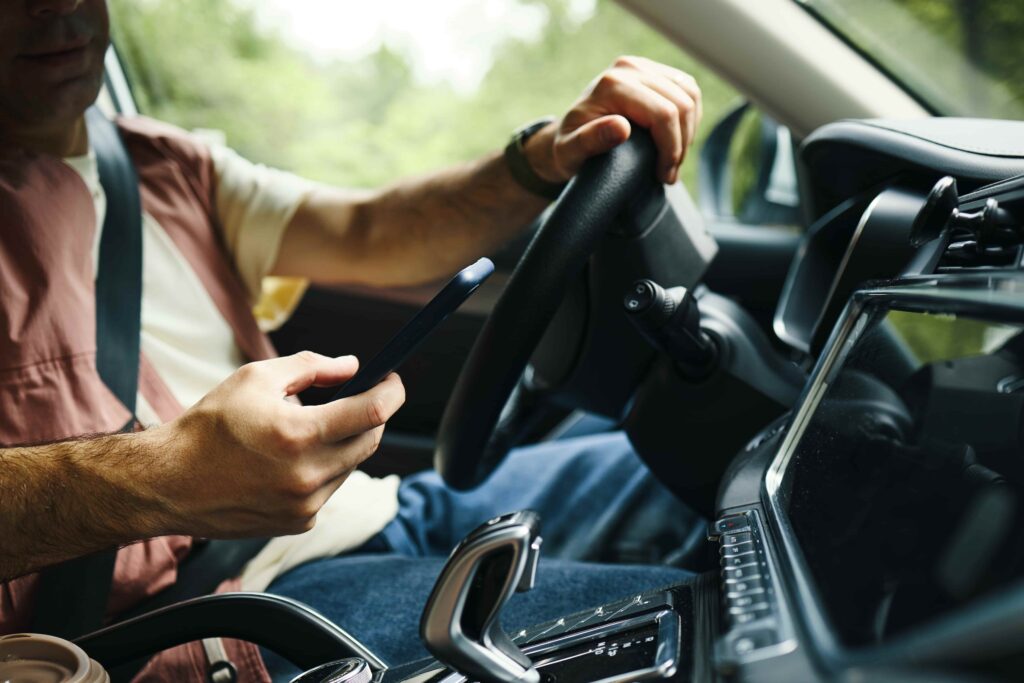
Distraction behind the wheel can have life-altering consequences for others on the road. When a driver’s inattention causes a crash, the legal and financial burdens often fall hardest on those least responsible.
Under Pennsylvania law, distracted driving is more than a traffic violation and a ticket. It is a form of negligence and a breach of the legal responsibility to drive safely—a duty that every motorist owes to others on the road. Fortunately, Pennsylvania law provides a path toward accountability and compensation for those injured by a distracted driver.
Knowing what to do if you’re hit by a distracted driver in Pennsylvania can help you and your car accident lawyer build a solid foundation for a personal injury claim. One that puts you in the best possible position to secure the compensation you need to recover.
Key Takeaways for Distracted Driver Car Accident Claims in Pennsylvania
- Distracted driving is a civil offense under Pennsylvania law and may result in liability for injuries caused by the distracted driver.
- You may still have a valid personal injury claim even if the other driver denies fault. A personal injury attorney can help establish negligence through phone records, witness testimony, and more.
- Comparative negligence rules apply in Pennsylvania, which means partial fault does not necessarily prevent you from recovering compensation.
- Hiring a personal injury attorney early helps preserve evidence, manage interactions with insurers, and protect your claim value.
- Medical care is critical, but it is only part of what supports your case—you will also need to document the impact of your injuries on daily life, work, and relationships.
Pennsylvania Distracted Driving Laws
Distracted driving is defined under 75 Pa. C.S. § 3316, which prohibits using an “interactive wireless communication device” to read, write, or send text-based communication while operating a vehicle. Pennsylvania law allows local law enforcement to cite drivers who text while driving, even if no accident occurred.
However, a traffic citation alone is not enough evidence to recover damages. In civil court, an injured party must show that the driver’s distraction directly caused the accident and injuries. This turns a violation of the law into a civil liability issue—one that allows you to pursue compensation through a personal injury claim.
What Should I Do Right After a Distracted Driving Accident?
If you were recently involved in a crash caused by a distracted driver, you likely already received or are receiving medical care. That is the first priority. Beyond your immediate medical issues, taking other critical steps can help you protect your legal claim and its value.
Here is what you should do next:
What Should I Do Right After a Distracted Driving Accident?
Once you have received medical attention, there are critical steps you can take to protect your legal rights. Taking these simple steps helps protect your legal claim and its value.
Hire a personal injury attorney
Distracted driving cases often hinge on details that are difficult to uncover without legal intervention. An attorney can act quickly to obtain time-sensitive evidence, such as phone usage data, surveillance footage, or traffic camera recordings, that may otherwise be lost. Legal counsel also ensures that insurers do not undervalue or dismiss your claim.
Attend all medical appointments and follow through with treatment
Insurance carriers routinely review your medical records for gaps in care, missed appointments, or inconsistent treatment. Following your doctor’s treatment plan and keeping your follow-ups helps you recover and shows that your injuries are real and serious.
Document your recovery in a journal
Your attorney can use these personal records to illustrate the full extent of your damages. Keep daily notes about your physical limitations, pain levels, emotional distress and suffering, sleep disruption, or changes in your ability to work or participate in family life. Doing this creates a record that medical charts alone do not capture.
Avoid speaking with the at-fault driver’s insurance company
Insurance adjusters may use any statement you make, no matter how casual, to shift more fault for the accident to you or reduce the value of your claim. Refer all communication to your attorney. You are under no obligation to speak with the opposing insurer. Under no circumstances should you give a recorded statement. Sometimes insurance adjusters will pose as investigators or even police.
Preserve any photos, notes, or documentation from the crash scene
Even informal snapshots or written observations can support your account of events. If you captured anything at the scene, such as damage to vehicles, traffic conditions, or your injuries, save it securely and share it with your legal team.
These steps can help strengthen your case’s foundation. The more complete the evidence, the more effectively your legal team can advocate for compensation under Pennsylvania’s distracted driving and personal injury laws.
Under no circumstances should you post anything on the internet or social media about the crash or your injuries. If you have posted something, do not take it down but immediately let your attorney know about it.
Is Distracted Driving Considered Negligence in Pennsylvania?
Yes. Under Pennsylvania civil law, distracted driving is treated as a form of negligence. If a driver failed to pay full attention to the road and caused an accident as a result, they may be held legally responsible.
Negligence occurs when someone fails to exercise reasonable care, leading to harm. In the context of a distracted driving accident, this could include:
- Texting or checking notifications while driving
- Using GPS or changing music on a phone
- Eating or grooming behind the wheel
- Reaching for objects instead of keeping hands on the steering wheel
Proving driver negligence in these situations often requires specific types of evidence. A qualified personal injury attorney will know how to obtain and present this information to support your claim.
Fault Determination and Comparative Negligence in Pennsylvania
In Pennsylvania, the rule of comparative negligence (42 Pa. C.S. § 7102) determines how much compensation you may obtain in an accident if you are determined to be partially at fault.
Under the state’s 51% bar rule, you may recover damages as long as you are not more than 50% at fault for the crash.
Here is how it works:
- If the distracted driver is 100% at fault, you may pursue full compensation.
- If you are found 10% at fault and the distracted driver 90%, your compensation will be reduced by 10%.
- If you are 51% or more at fault, you cannot recover damages under Pennsylvania law.
This legal framework makes fault determination a critical part of every distracted driving injury claim. Insurance companies may try to shift blame to minimize their payout. Your attorney’s role is to push back against unfair fault assessments and advocate for your full recovery.
What if the Distracted Driver Denies Fault?
This is a common concern. Many drivers who cause crashes due to distraction will not admit fault, especially if their actions were illegal. Fortunately, you do not need the other driver to admit fault to move forward with a personal injury claim.
Your attorney can investigate and build a strong case using:
- Cell phone records that show activity at the time of the crash
- Dashcam or surveillance footage from nearby businesses or traffic cameras
- Witness statements from passengers, bystanders, or other motorists
- Accident reconstruction reports to show timing and cause
- Police crash reports, which may include observations about the driver’s behavior
Even without direct evidence of phone use, patterns of inattention and erratic driving can support a finding of negligence. Legal action is not based on confession. It is based on proof.
How Do Insurance Companies Handle Distracted Driving Cases in PA?
Insurance companies typically evaluate distracted driving crashes like any other form of driver negligence. However, they may minimize or dispute the claim, especially if you lack clear proof of distraction.
- Arguing that there is no “hard evidence” to prove the driver was distracted
- Claiming your injuries are less serious than you say they are
- Attempting to assign partial fault to you to reduce payout
- Offering fast, low settlements before you speak to an attorney and understand your claim’s full value
Unfortunately, many people trust insurance companies to do the right thing and automatically pay them what their claim is worth. But that is seldom the case. Their goal is to resolve the claim with the least financial impact on them.
Who Pays After a Distracted Driving Crash in Pennsylvania?
Pennsylvania operates under a system where medical benefits that you have purchased are paid without regard to fault.
First-Party Benefits (PIP)
When a crash occurs in Pennsylvania, your own auto insurance policy pays your medical expenses through First-Party Benefits (PIP)—often called personal injury protection—regardless of who caused the crash. This ensures survivors receive immediate coverage for injuries without waiting for fault to be determined.
The choice: limited tort vs. full tort
At the time of purchasing or renewing your auto policy, you must choose between two tort options:
- Limited tort (restricts the right to sue) lets you obtain your PIP for medical costs but restricts your right to sue for emotional distress and pain and suffering. You can only pursue non-economic damages if your injuries qualify as legally “serious” (such as permanent impairment or disfigurement).
- Full tort (claim without restrictions) allows you to recover both economic (medical bills, lost wages) and non-economic damages (pain and suffering), regardless of any specific threshold. Of course severity always plays a role in the value of a claim.
Other considerations
The Pennsylvania Financial Responsibility Law is very complex. There are questions of underinsurance and uninsured motorist coverage. You may have one or both. Some people will specifically sign-down and take less coverage than they would otherwise be entitled to. Typically, bodily injury protection which protects you, the driver, is the same for the available underinsurance or uninsured motorist coverage. However, some people take less coverage than they are entitled to. People waive a feature of protection called “stacking.” A lawyer must look at the underwriting forms to see if you have waived any protections that you may be entitled to. This is very crucial and you need to hire a lawyer who is very familiar with the Financial Responsibility Law.
Why it matters in a distracted driving case
The insurance coverage you selected—limited tort or full tort—determines whether you can pursue compensation beyond your own first-party medical benefits. Once those benefits are exhausted, or if your injuries qualify under the serious injury threshold, the next question becomes whether you may file a claim directly against the distracted driver.
A personal injury attorney will analyze your specific insurance policy and the other driver’s coverage to determine what compensation is available and from whom.
Suing a Distracted Driver in Pennsylvania
If your injuries meet Pennsylvania’s legal standards and the distracted driver’s negligence caused the crash, you may bring a civil claim for compensation. This type of claim is separate from the insurance coverage discussed earlier. It allows you to seek financial recovery directly from the at-fault driver for both economic and non-economic losses.
This is not a criminal case. It is a civil liability action where you seek financial recovery for:
- Medical expenses
- Lost income and reduced earning capacity
- Emotional distress and suffering
- Long-term disability or impairment
- Loss of enjoyment of life
Most distracted driving claims resolve through settlement, but insurers do not always offer fair compensation. Preparing a case as if it will go to trial strengthens your position and often leads to a more favorable settlement.
How Long Do I Have to File a Distracted Driving Injury Claim?
Under 42 Pa. C.S. § 5524, the statute of limitations for personal injury actions in Pennsylvania is two years from the date of the accident. This deadline applies to civil claims arising from distracted driving crashes, including those seeking compensation for medical expenses, lost income, and non-economic damages such as emotional distress and suffering.
Failing to file within the two-year period bars the court from hearing your case, regardless of its merits. Although limited exceptions may apply, such as when the injured person is a minor or when an injury is not discovered until later, these situations are uncommon and subject to strict legal interpretation.
Taking prompt legal action is important for more than just compliance with the statute. Evidence that supports a distracted driving claim, such as phone records, surveillance video, and witness statements, can be lost or become less reliable with time. Early involvement of an attorney helps preserve this valuable evidence.
FAQs About What to Do if You’re Hit by a Distracted Driver in Pennsylvania
What should I do if I did not get medical care immediately after the crash?
If you have not yet received medical attention, do so right away. Some injuries, such as concussions or soft tissue trauma, may not appear for hours, days, or longer. A medical record also provides crucial documentation that supports your claim.
How do I know if the other driver was distracted?
You may not know for certain, but your attorney can obtain phone records, video footage, and witness accounts to investigate the distraction. Distracted driving cases are often proven through circumstantial evidence and legal analysis.
What happens if the distracted driver was working at the time of the crash?
If the driver was acting within the scope of their employment, their employer may also be liable under Pennsylvania’s respondeat superior doctrine. This opens up additional paths to compensation through corporate insurance policies.
Can I file a claim if I was a passenger?
Yes. Passengers injured in distracted driving accidents have the same rights to pursue compensation as drivers. You may file a claim against the at-fault driver, even if they were in your vehicle.
Will filing a claim increase my own insurance premiums?
Not typically, if you were not at fault. Insurance rate increases are tied to fault, and Pennsylvania law prohibits insurers from raising premiums for uninsured or underinsured motorist claims when the insured is not responsible for the crash.
What if I was a pedestrian or bicyclist hit by a distracted driver?
Pedestrians and bicyclists injured by a distracted driver in Pennsylvania have the same rights to pursue compensation as those in vehicles. Your claim would proceed similarly, focusing on proving the driver’s negligence and documenting your injuries and losses.
An attorney can explain the specific laws and insurance considerations that apply to pedestrian and bicycle accidents.
How long does a distracted driving claim take to resolve?
The duration of a distracted driving claim varies widely depending on the complexity of the case, the severity of injuries, and the willingness of insurance companies to negotiate fairly. Some claims resolve relatively quickly through settlement, while others may require more extensive investigation or litigation.
Your attorney can provide a more specific estimate after reviewing the details of your case.
Speak to a Pennsylvania Personal Injury Attorney Today
When you are recovering from a distracted driving accident, the last thing you should worry about is managing legal details, negotiating with insurers, or tracking down proof of another driver’s negligence.
At Rieders Travis Dohrmann Mowrey Humphrey & Waters, we provide personal injury representation grounded in Pennsylvania law and built on decades of experience. With a proven record of obtaining meaningful settlements and verdicts for our clients and a deep familiarity with the Lycoming County court system, our team is equipped to advocate for an outcome that matches your needs.
We handle every step of the distracted driving injury claim process, from collecting evidence and evaluating your injuries to negotiating with insurance carriers and preparing for trial if needed. Our attorneys approach each case with the care, clarity, and legal precision our clients expect.
Contact Rieders Travis Dohrmann Mowrey Humphrey & Waters at (570) 323-8711 or contact us online for a free telephone consultation regarding your personal injury from distracted driving. Our attorneys will evaluate your case and help you explore your best legal options.
